Quick answer: Not necessarily. A big hot tub does not automatically require a heat pump. However, as water volume and heating demand increase, a heat pump becomes more worth evaluating-especially when the hot tub is used frequently, kept at temperature for long periods, or operated in a cooler climate. The decision should be based on water volume, target temperature, climate, insulation, cover use, desired heat-up time, electricity price and actual equipment performance.
SpaRelax will inform you about the demand for using the heat pump, its value, suitable large hot tubs, etc. It provides you with comprehensive knowledge about heat pumps.
Why Big Hot Tubs Have a Different Heating Requirement
A larger hot tub contains more water and often has a larger exposed surface. More water requires more energy for the same temperature increase, while a larger exposed surface can increase heat loss, particularly through evaporation when the cover is removed.
ASHRAE's heating guidance treats spa heating as a function of temperature, initial temperature, volume and heat loss. This means heater sizing should not be based on water volume alone.
Source: ASHRAE Handbook, Chapter 50, Service Water Heating.
Comparing different types of Hot Tubs
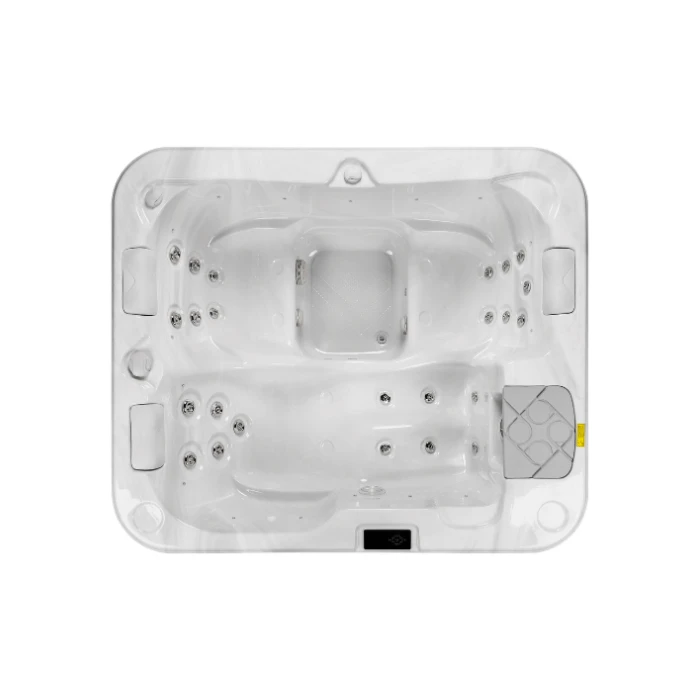
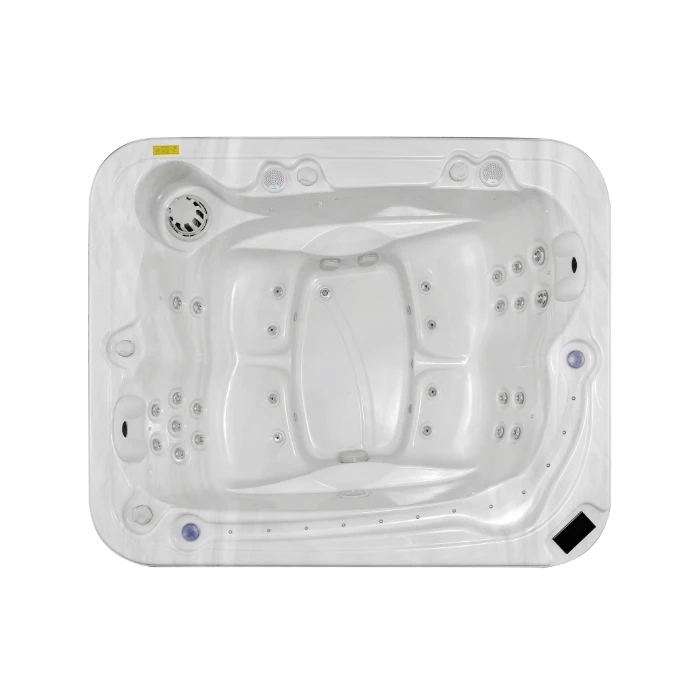
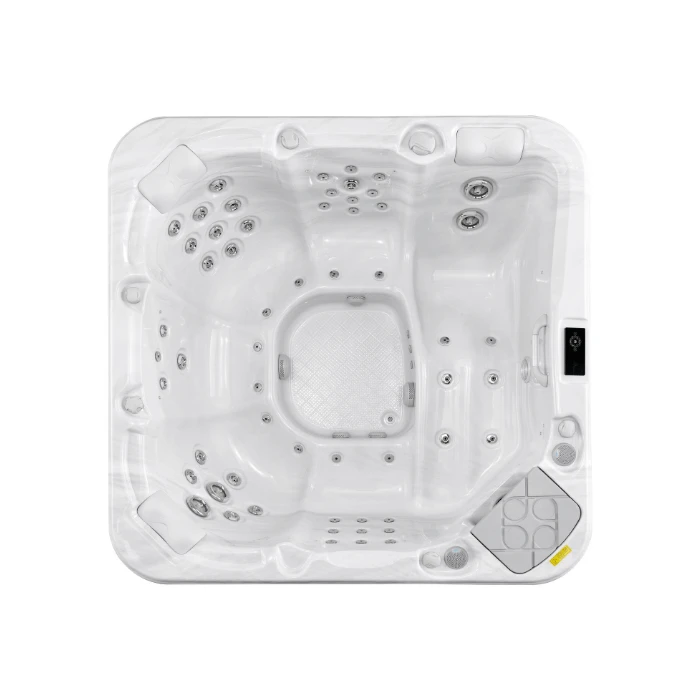
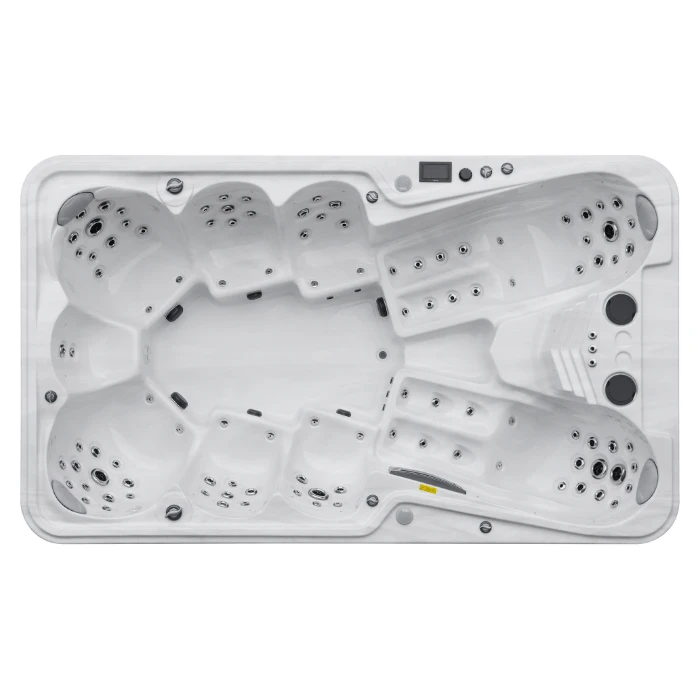
Compare the 4 models of hot tubs from SpaRelax. One is a small 3-person hot tub, another is a compact 4-person hot tub, the common 6-person hot tub, and one is a large 10-person hot tub.
| products |
 |
 |
 |
 |
| Model number | SpaRelax 3A10 | SpaRelax 4A13 | SpaRelax 6A12 | SpaRelax 9A70 |
|
Dimensions(cm) |
205 x 175 x 79/81 | 200× 165 × 81/83 | 200 x 200 x 88/90 | 380x 225x 92 |
| Capacity | 3 adults | 4 adults | 6 adults | 9 adults |
| Water Capacity | 786 liters | 900 liters | 1039 liters | 2520 liters |
Let's take a look at this group: SpaRelax 3A10 is a 3-person hot tub, and SpaRelax 4A13 is a 4-person hot tub. However, the dimensions of 3A10 (205 × 175 cm) are actually larger than those of 4A13 (200 × 165 cm), covering an area of approximately 3.59 square meters, while 4A13 only covers about 3.30 square meters. This is because the design orientation and target audience of these two models are different.
They are all designed for home use, but the SpaRelax 4A13 adopts a more compact design. The designers of SpaRelax gave priority to space utilization when planning. Therefore, although it can accommodate one more person, the size of the hot tub has not been increased. The SpaRelax 3A10 has a reclining position, which is more suitable for various massage experiences in different postures, and the overall space feeling is also more spacious.
The result is: The SpaRelax 4A13 hot tub has all the seats, which saves more space but requires more water - 900 liters, while the 3A10 model requires 786 liters. The average water consumption per person is 225 liters and 262 liters respectively. This once again indicates that the relationship between the number of people and water consumption is not a simple direct proportion.
Let's take a look at the SpaRelax 6A12 hot tub. It is a classic 6-person hot tub that has been selling well for many years. The base measures approximately 200 x 200 cm, which is roughly 4 square meters. It is equipped with 1 reclining seat and 5 seating positions. The seats come in various designs and are paired with different-sized nozzles, providing different massage experiences. Its water capacity is 1039 L, and on average, each person uses about 173 L. It is the most "efficient" among these models in terms of water usage.

Finally, let's take a look at the SpaRelax 9A70 hot tub. Its water consumption is significantly higher: with dimensions of 380 × 225 cm, it covers an area of approximately 8.55 m², which is about 2.4 times that of the 3A10; it can accommodate 9 people, including two reclining seats, and even the angle for leg placement has been specially adjusted by the professional designers of SpaRelax. The water capacity reaches 2520 L, which is about 3.2 times that of the 3A10, with an average water volume of approximately 280 L per person. The SpaRelax 9A70 hot tub is specifically designed for large families or for group spa treatments. It also has another name, Patry SPA.
Returning to the initial question - why do big hot tubs have different heating requirements? The data has provided the answer. By converting the specific heat capacity of water (4.186 kJ/(kg·°C)) and the density (1 kg/L), the theoretical heat required for a 1°C increase in water temperature (excluding pump losses and heat dissipation losses) is calculated.
For models like 9A70, whose water volume is more than three times that of a small bathtub, this means that the energy required for each 1°C increase in temperature almost triples; at the same time, the exposed surface area of the water body and the shell is also larger, and when the cover is opened, the evaporation and heat dissipation rates are faster.
Therefore, "big" does not merely refer to the number of seats, but rather to the increase in overall volume and surface area, resulting in higher heating and insulation loads. This is why when choosing a big hot tub, one must not only consider the number of people but also pay attention to the water capacity and floor area.
Do Big Hot Tubs Need More Heating Power?
Usually, they have a higher heating demand-but that does not mean they automatically need a heat pump. For water, the heat-up relationship can be simplified as Q = m × cp × ΔT. ASHRAE gives water specific heat as approximately 4.1868 kJ/kg·K. Actual sizing also needs ongoing heat-loss calculations.
Source: ASHRAE Handbook, Chapter 50, SI edition.
Do You Need a Heat Pump for Your Big Hot Tub? Ask These 6 Questions
Lorem ipsum dolor sit amet consectetur adipisicing elit.
How large is the water volume?
More water requires more energy for the same temperature rise.
How often do you use the hot tub?
Frequent use makes long-term heating efficiency more important.
Do you keep the water warm all the time?
Long temperature-maintenance periods increase the importance of operating efficiency.
What is your outdoor climate?
Air-source heat-pump performance changes with outdoor temperature.
How quickly do you need to heat the water?
A direct electric heater may offer faster, more predictable heat-up.
How well is the hot tub insulated and covered?
Reducing heat loss can be as important as selecting the heating source.
How Does a Heat Pump Work on a Big Hot Tub?
An air-source heat pump uses electricity to move heat from surrounding air into the water rather than generating all heat directly through electrical resistance. ENERGY STAR describes this same heat-transfer principle for heat-pump water heaters.
Heat-pump efficiency is commonly expressed as COP, or Coefficient of Performance: heating output divided by electrical input under stated test conditions. COP must always be interpreted together with those test conditions.
Sources: ENERGY STAR, How It Works - Heat Pump Water Heaters; ENERGY STAR Heat Pump Equipment Key Product Criteria.
Heat Pump vs Electric Heater for a Big Hot Tub
Neither system is universally better. The appropriate choice depends on the project's priorities.
|
Factor |
Heat Pump |
Direct Electric Heater |
|
Heating principle |
Transfers heat from surrounding air |
Converts electrical energy directly into heat |
|
Efficiency |
Can be substantially higher under suitable conditions |
Direct resistance heating is approximately 1:1 at point of use |
|
Initial cost |
Usually higher |
Usually lower |
|
Long-term heating |
Often attractive for frequent/extended use |
Simple, but electricity use can be higher for long heating periods |
|
Heat-up speed |
Depends on capacity and outdoor conditions |
Usually fast and predictable for a given rating |
|
Cold weather |
Performance changes with outdoor temperature |
Less dependent on outdoor air |
|
Installation |
External unit and water connections may be required |
Often simpler when integrated |
|
Best fit |
Efficiency-focused, frequent or long-duration heating |
Simple, occasional or rapid heating |
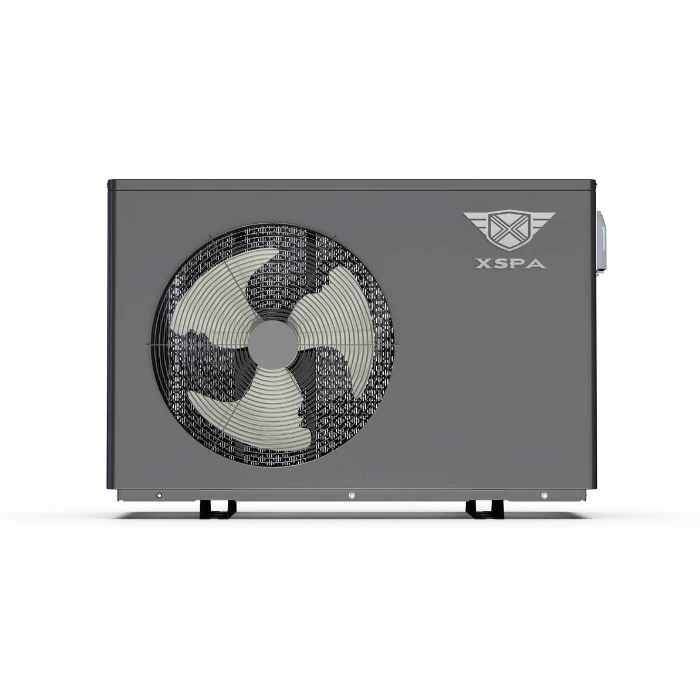
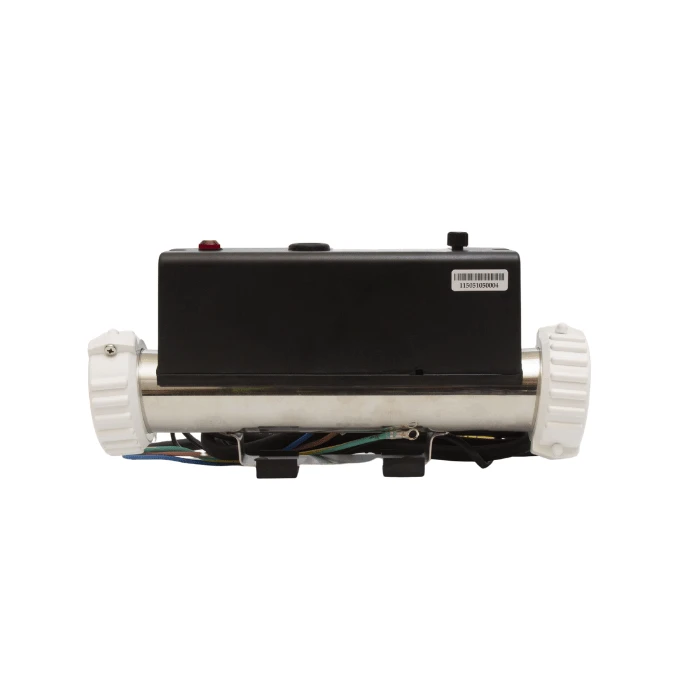
Important: do not compare a heat pump's maximum COP with an electric heater's nominal rating as if they were the same metric. Compare delivered heat, input power and test conditions.
Now, you can make the choice of whether to use a Heat Pump or not.
When Should You Consider a Heat Pump for a Big Hot Tub?
You use the hot tub frequently:If the tub is used several times a week or every day, energy use over the operating season becomes more important.
You keep the water at a ready-to-use temperature:Maintaining temperature for long periods creates ongoing heat demand.
You live in a cool climate:Cooler air can increase heat loss and change air-source heat-pump capacity and COP.
You have a large water volume:Large hot tubs require more energy for a given temperature rise.
You want lower long-term electricity consumption:A heat pump can deliver more heat output than electrical input under suitable conditions.
When You May Not Need a Heat Pump
A big hot tub does not automatically justify the added cost and installation complexity of an external heat pump. A conventional electric heater may be appropriate when:
The hot tub is used only occasionally.
The climate is warm and heating demand is limited.
Fast heat-up is more important than long-term efficiency.
The existing electric heater already meets the required performance.
There is no suitable location for an external heat pump.
Expected operating hours are too low to justify additional equipment cost.
How Much Does It Cost to Heat a Big Hot Tub?
There is no universal monthly cost. Heating energy depends on water volume, target temperature, outdoor temperature, cover use, insulation, wind, operating schedule, heating-system performance and local electricity price.
For a simplified heat-up estimate, use Q = m × cp × ΔT. Ongoing energy demand must then account for evaporation, convection, radiation and conduction.
ENERGY STAR's pool-energy model identifies evaporation, convection, long-wave radiation and conduction as heat-loss mechanisms. DOE data likewise identify evaporation as a major source of outdoor pool heat loss.
Sources: ENERGY STAR Swimming Pools Technical Reference; U.S. DOE Energy Savings Potential and RD&D Opportunities for Commercial Building Appliances.
Why the Hot Tub Cover Matters?
A heat pump cannot eliminate heat loss. A well-fitted thermal cover reduces the heat that must be replaced by any heating system.
ENERGY STAR reports that covering a heated pool when it is not in use can reduce pool heating costs by as much as 50%–70%. EPA WaterSense also reports 50%–70% heating-cost savings for heated pools, depending on climate. These are pool figures, not a guarantee for a hot tub, but they demonstrate the importance of controlling evaporation and heat loss.
Sources: ENERGY STAR Pool Pumps; EPA WaterSense Labeled Homes Technical Sheet, July 2023.
Does a Heat Pump Save Money on a Big Hot Tub?
It can, but the result depends on operating conditions. A heat pump can move more thermal energy into water than the electrical energy it consumes because it transfers heat from surrounding air. The advantage is generally more relevant when the tub operates frequently or maintains temperature for long periods.
DOE research on heat-pump water heaters supports the efficiency advantage of heat-pump technology over electric resistance in domestic water-heating applications. However, those studies are not hot-tub tests, so their savings percentages should not be presented as guaranteed hot-tub savings.
Source: U.S. DOE, Heat Pump Water Heaters Achieve Significant Peak Reduction and Energy Savings.
Does a Heat Pump Heat a Big Hot Tub Faster?
Not necessarily. A heat pump is mainly attractive for efficient heating and temperature maintenance. A direct electric heater may provide faster and more predictable heat-up depending on its power rating and the hot-tub design.
For a large hot tub, heat-up time depends on water volume, temperature rise, heater output, heat loss and starting conditions.
Can a Big Hot Tub Use Both a Heat Pump and an Electric Heater?
Some systems can use both, but this is a system-design question. A combined configuration can allow efficient temperature maintenance while retaining additional electric heating capacity when higher demand or faster recovery is required. Compatibility depends on the control system, electrical supply, water flow and equipment design.
What Size Heat Pump Does a Big Hot Tub Need?
Water volume alone is not enough to select heat-pump capacity. Consider:
Water volume
Target water temperature
Starting water temperature
Outdoor design temperature
Insulation and cabinet construction
Hot tub cover
Desired heat-up time
Expected heat loss
Frequency of use
Heat-pump capacity and COP at relevant conditions
ASHRAE's methodology separates the energy needed to raise water temperature from ongoing surface heat loss. A responsible supplier should therefore request project conditions before recommending a heat-pump size.
Source: ASHRAE Handbook, Chapter 50.
What Else Affects Big Hot Tub Heating Efficiency?
Thermal insulation : Good insulation reduces heat transfer from the water and plumbing to the environment.
Thermal cover : Covering the tub when not in use can substantially reduce evaporation and heating demand.
Cabinet construction : The cabinet and insulation system influence side and base heat loss.
Water circulation: Heating equipment needs the specified water flow for stable operation.
Outdoor temperature and wind : Both can affect heat loss and air-source heat-pump performance.
Usage pattern : Long periods with the cover removed increase heat loss.
Target water temperature : A higher set point generally increases the temperature difference between water and surroundings.
Where Should a Heat Pump Be Installed for a Big Hot Tub?
Do not use one generic clearance distance for every heat-pump model.
Please have it installed by a professional electrician.
- Near the big hot tub where practical, while meeting plumbing requirements.
- On a stable, level base suitable for the equipment.
- Where air inlet and outlet have adequate clearance.
- Where discharged air will not be trapped or recirculated.
- Where service access is available.
- According to the heat-pump manufacturer's installation manual.
An external heat pump normally connects to the hot tub's water circulation circuit. A typical arrangement can include a circulation pump, water inlet, water outlet and isolation valves. A bypass may be required in some designs, depending on flow requirements and the overall plumbing system.
For OEM and project supply, pre-planned connection points and clear flow labels can reduce installation uncertainty after delivery.
Big Hot Tub Heat Pump Purchase Guide
After understanding, I believe you will be able to make a positive judgment on the following information.
7 Questions to Ask Before Buying
- What is the heating capacity at my actual outdoor design temperature?
- What is the COP at my real operating conditions?
- What is the minimum outdoor operating temperature?
- What water flow does the heat pump require?
- Is it compatible with my hot-tub control system?
- Does the plumbing require a bypass or isolation valves?
- What installation clearance, electrical supply and service access are required?
Only by understanding the hot tub heat pump can you make the most of it.
Big Hot Tub Heat Pump Buying Checklist
- Confirm water volume.
- Confirm target water temperature.
- Record local outdoor temperature range.
- Compare heating capacity at realistic conditions.
- Compare COP at realistic conditions.
- Set a realistic heat-up-time expectation.
- Check insulation and thermal cover.
- Check required water flow.
- Check electrical requirements.
- Check control-system compatibility.
- Confirm plumbing and valve requirements.
- Confirm installation and service space.
- Compare total ownership cost, not just purchase price.
So, Should You Buy a Heat Pump for Your Big Hot Tub?
|
Situation |
What to Consider |
|
Large hot tub + frequent use |
Heat pump is worth evaluating |
|
Large hot tub + long temperature maintenance |
Heat pump is worth evaluating |
|
Cool climate |
Check low-temperature capacity and COP |
|
Priority is long-term efficiency |
Heat pump may be attractive |
|
Occasional use |
Electric heating may be sufficient |
|
Warm climate |
Heat pump may be optional |
|
Fast heat-up is the priority |
Compare direct electric heating |
|
Existing heater meets requirements |
Heat pump may not be necessary |
Bottom line: A big hot tub does not automatically need a heat pump. But as water volume, usage frequency and heating demand increase, a heat pump becomes increasingly worth evaluating-provided its performance matches the local climate and the hot tub is properly insulated and covered.
How a Professional Hot Tub Manufacturer Can Help
For a distributor, hotel, vacation-rental operator or project buyer, the heating system should be considered together with the hot-tub specification. SpaRelax is confident that it can offer the following services to facilitate the implementation of the recommended procurement projects.
Heating configuration
Evaluate size, water volume, target temperature, climate and usage before selecting the heating configuration.
Insulation and cover
Heating efficiency depends on the whole system, not the heat pump alone.
Pre-planned plumbing
Where the configuration allows, prepare connection points and identify flow direction before shipment.
Control-system compatibility
Confirm that heat pump, electric heater and control system work together as intended.
OEM & ODM support
Heating configuration can be discussed as part of the complete private-label or project spa specification.
Technical support
Provide installation information and technical support for distributors and installers.
FAQ: Big Hot Tub Heat Pumps
Q: Do I need a heat pump for my big hot tub?
A: Not necessarily. It is more worth considering when the tub is large, frequently used, kept warm for long periods, or operated in a cooler climate.
Q: Is a heat pump worth it for a large hot tub?
A: It can be, especially when long-term heating efficiency matters. The answer depends on usage, climate, insulation, electricity price and equipment cost.
Q: Are big hot tubs more expensive to heat?
A: They can require more heating energy because they contain more water and may have a larger exposed surface. Actual cost also depends on insulation, cover use, climate and heating technology.
Q: How much does it cost to heat a big hot tub?
A: There is no universal cost. Consider heat-up energy and ongoing heat loss using water volume, temperature difference, climate, cover, insulation, heater performance and electricity price.
Q: What size heat pump do I need for a big hot tub?
A: The correct size depends on water volume, target temperature, climate, heat loss and desired heat-up time. Water volume alone is insufficient.
Q: Is a heat pump better than an electric heater for a large hot tub?
A: A heat pump can be more efficient under suitable conditions, while an electric heater can provide simpler and faster heat-up. The better fit depends on the use case.
Q: Can a heat pump heat a big hot tub in winter?
A: It can if the selected model is designed for the expected outdoor temperature. Check low-temperature capacity and operating limits.
Q: Can I use a heat pump with an electric heater?
A: Some systems can, but compatibility depends on the control system, electrical design, water flow and manufacturer configuration.
Q: Does insulation affect big hot tub heating cost?
A: Yes. Better insulation and a well-fitted cover reduce heat loss, lowering the amount of heat the heating system must replace.
Q: Does a big hot tub need a stronger circulation system?
A: Not automatically. The circulation system should meet the flow requirements of the spa and connected heating equipment.
SpaRelax product can be combined with the big hot tub heat pump solution, significantly reducing the heating energy consumption and operating costs of the big hot tub. Based on the selected SpaRelax model and in accordance with the site environment, the heat pump selection and pipeline matching scheme can be customized.
Please feel free to inform us of the project information for consultation, and we will provide you with the quotation and technical solution for the complete set of equipment that is suitable for your needs.