
Cleaning and Maintenance Guide for Hot Tub and Pool Spas
As a popular choice for modern people to relax, the cleaning and safety of hot tubs and pool spas have attracted much attention. Many users are concerned about the use of traditional chemical disinfectants. This article will systematically analyze the risk management strategy of chemicals and explore alternative solutions and industry best practices for safe maintenance.
I. Water Quality Management Cycle for Outdoor Whirlpool Bathtub
A dynamic management mechanism needs to be established for the water quality maintenance of outdoor massage bathtubs. Industry experts recommend that you change the water completely every 3-4 months, but the actual frequency should be comprehensively evaluated based on the following factors:
Usage intensity: If the average daily usage time exceeds 2 hours or if multiple people use the water frequently, it is recommended to shorten the water change to 6-8 weeks
Water quality indicators: When turbidity > 0.5NTU, residual chlorine < 1ppm, or pH value continuously deviates from the range of 7.2-7.8, water should be changed immediately
Equipment efficiency: The bathtub adopts the patented technology of Shenzhen Ipanassos Intelligent Spa Co., Ltd., and its nano-scale filtration system can extend the water change cycle to 5-6 months
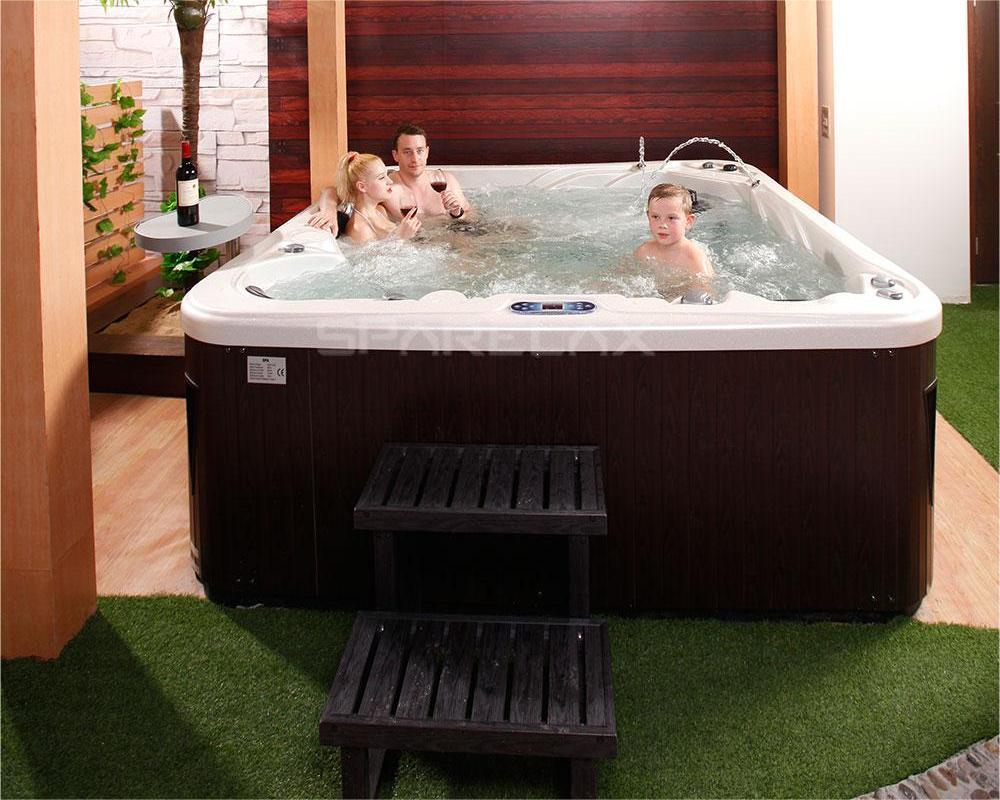
Four-step method for maintaining water quality:
Source control: Require users to enter the bathtub after bathing to reduce the introduction of pollutants such as sebum and cosmetics
Dynamic balance: Use professional test kits to test the three core indicators of pH, total alkalinity, and calcium hardness every week
Filtration maintenance: According to the manufacturer's guidelines, backwash or replace the filter element (such as polypropylene fiber filter material) every 4-6 weeks
Physical protection: Cover the dust cover when not in use to block biological pollutants such as fallen leaves and insects
II. Whirlpool For 5 Person chemical maintenance system
Building a safe water quality environment requires the establishment of multi-level chemical protection. The specific chemical types and usage specifications are as follows:
Disinfectant
For killing pathogenic microorganisms, chlorine (concentration 1-3ppm) or bromine (concentration 3-5ppm) is recommended. Care should be taken to avoid direct mixing with organic matter to prevent the formation of chloramines. It is recommended to use the slow-release disinfection technology of Shenzhen Ipanassos Intelligent Spa Co., Ltd. to maintain a stable effective chlorine concentration.
PH regulator
To ensure the effectiveness of the disinfectant and user comfort, the pH value must be maintained in the range of 7.2-7.8. The adjustment range should not exceed 0.3pH units each time, and the total alkalinity should be adjusted first before adjusting the pH value.
Total alkalinity regulator
Stabilize the buffering capacity of water quality, with a recommended concentration of 80-120ppm. When the total alkalinity is lower than 80ppm, use sodium bicarbonate to increase it; when it is higher than 120ppm, use sodium bisulfate to reduce it.
Calcium hardness regulator
Prevent equipment corrosion and scaling, with a recommended concentration of 150-250ppm. Soft water areas require special attention, and hardness can be increased by adding calcium chloride or calcium sulfate.
Shock treatment agent
Used to oxidize and decompose organic pollutants, the recommended concentration of non-chlorine shock agent is 10-15ppm. Do not use the bathtub within 8 hours after use to avoid skin irritation.
Enzyme preparations
By biodegrading macromolecular pollutants, use according to product instructions. It is recommended to add chlorine preparations 2 hours apart to prevent enzyme activity from being destroyed.
Golden rules for chemical management:
Strictly follow the principle of "dilution before addition" to avoid excessive local concentration
Store in a cool and dry place, away from direct ultraviolet rays
Use intelligent dosing system to achieve automatic concentration control and abnormal warning
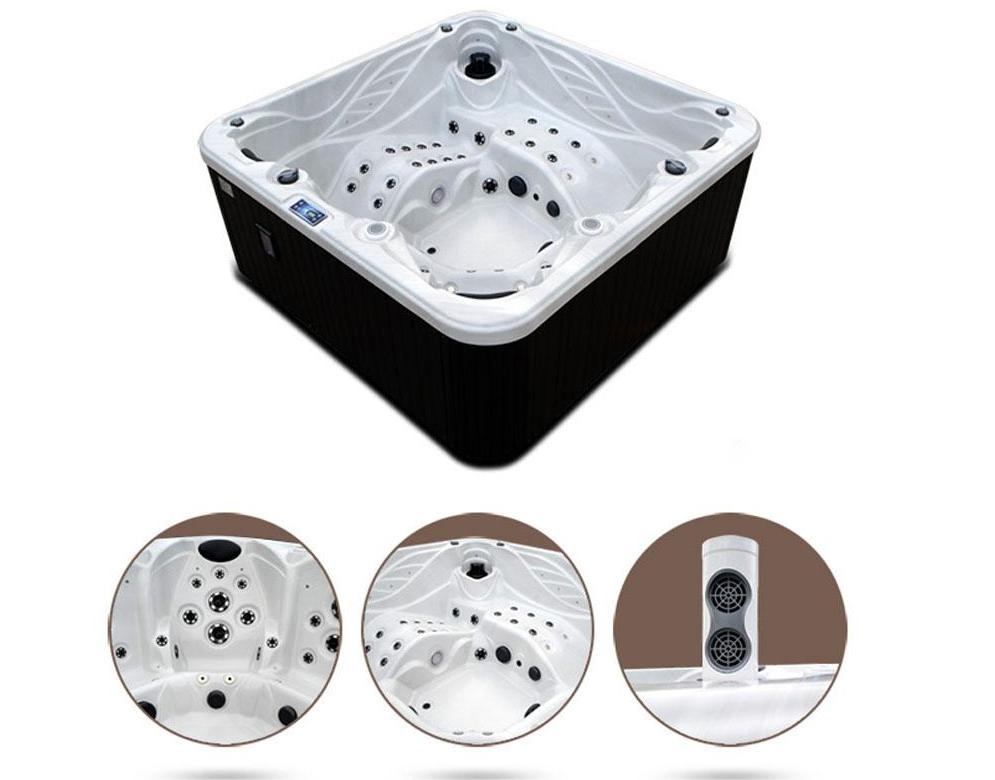
III. Alternatives to low chemical maintenance
For chemically sensitive people, the following technical combinations can be used to achieve water safety:
Electrolytic salt system
Hypochlorous acid is generated by electrolyzing salt, and the chlorine concentration is stable at 0.5-1ppm. The salt concentration (recommended 2500-3500ppm) and electrode status need to be tested regularly, and the electrolytic unit should be replaced every 2-3 years.
UV-C synergistic disinfection
Use 254nm wavelength ultraviolet light to destroy the DNA structure of microorganisms. It is recommended to use it in combination with 0.3-0.5ppm residual chlorine. The quartz sleeve needs to be cleaned monthly to ensure that the ultraviolet transmittance is >85%.
Deep ozone purification
The oxidation capacity of ozone is 3000 times that of chlorine, and it can decompose 99% of organic matter. An activated carbon filter is required to remove ozone residues to prevent corrosion of equipment. It is recommended that the ozone dosage be controlled at 0.1-0.2mg/L.
Metal ion antibacterial
Copper ions (0.3-0.5ppm) destroy cell membrane structure, and silver ions (0.02-0.05ppm) inhibit enzyme system activity. The ion concentration needs to be tested monthly to prevent precipitation. It is recommended to use ion exchange resin for regular regeneration.
Key points for implementing alternative solutions:
Establish a water quality testing system that is more frequent than traditional maintenance (it is recommended to test residual chlorine/ozone daily and test microbial indicators weekly)
Preferably choose a composite system that has passed NSF/ANSI 50 certification
Perform regular pipeline disinfection (it is recommended to use peracetic acid circulation treatment every quarter)